Quantum Error Correction Simulator Dashboard
Interactive Syndrome Visualizer & Decoder Playground
Click on data qubits to inject errors (blue for X, red for Z, purple for Y). Select the code configuration and decoder, then click Run Decoder to watch the decoder calculate and overlay the correction path in real-time.
Stabilizer / measurement check Active Defect (triggered check) Applied Correction
Live WebAssembly Benchmarking Dashboard
Run real-time Monte Carlo simulations directly inside your browser. Benchmark the logical error suppression rates of the Union-Find, Greedy, and Exact MWPM decoders across various code sizes and noise profiles.
Logical State Fidelity Bloch Sphere
Estimate the fidelity of the logical state under noise. This runs a mini Monte Carlo batch to measure expectations ⟨ XL ⟩, ⟨ YL ⟩, ⟨ ZL ⟩ by preparing cardinal states. The vector is drawn on the Bloch sphere below.
⟨ XL ⟩: -
⟨ YL ⟩: -
⟨ ZL ⟩: -
Threshold Analysis Plots
Both plots illustrate the relation between physical error rate (p) and logical error rate (p_L) for different code distances (d = 3, 5, 7).
Pure Data Noise (Perfect Measurements)
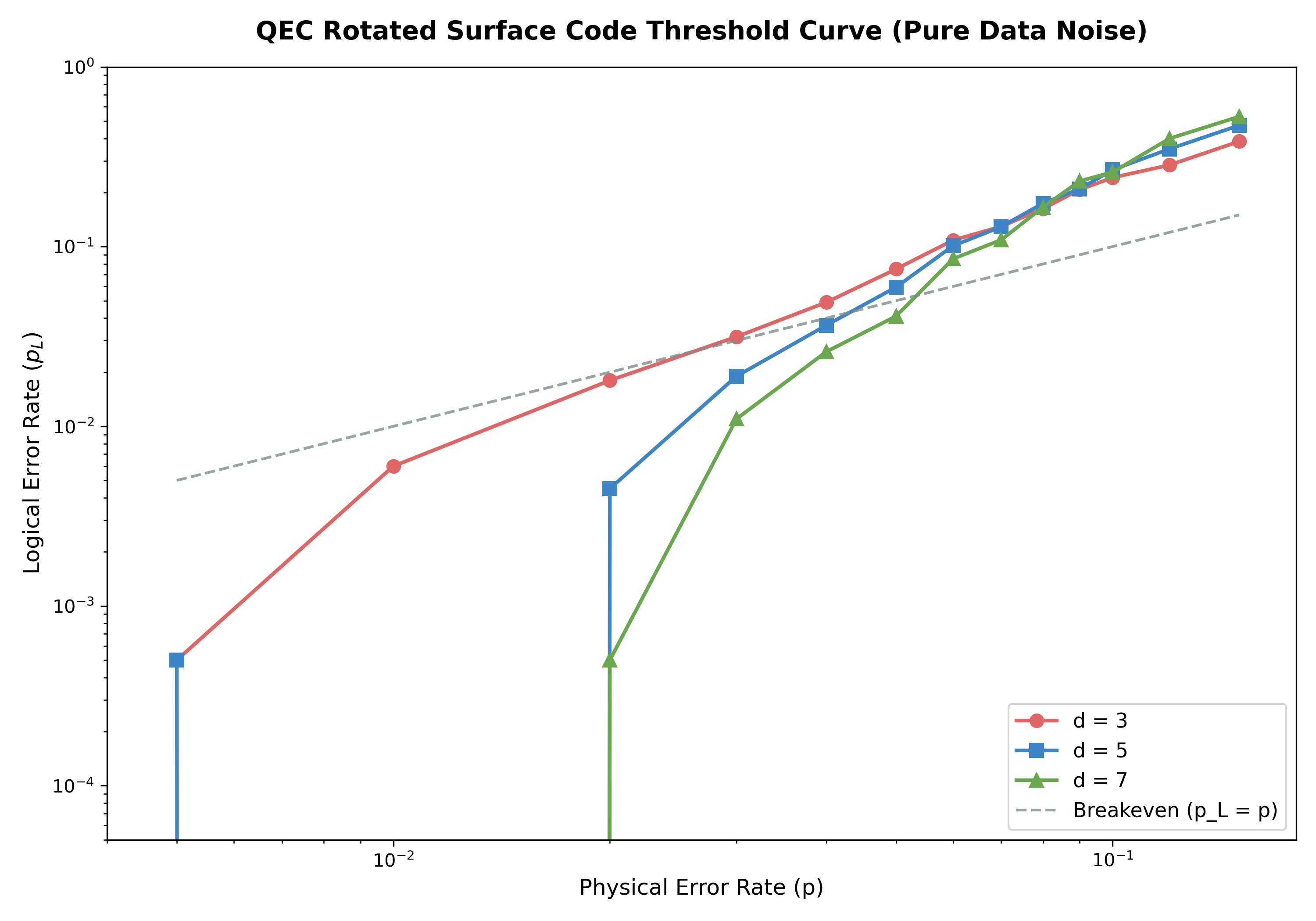
Crossing threshold is located at p ≈ 8.0%. Below this point, increasing code distance suppresses logical error rate.
Phenomenological Noise (Spacetime decoding)
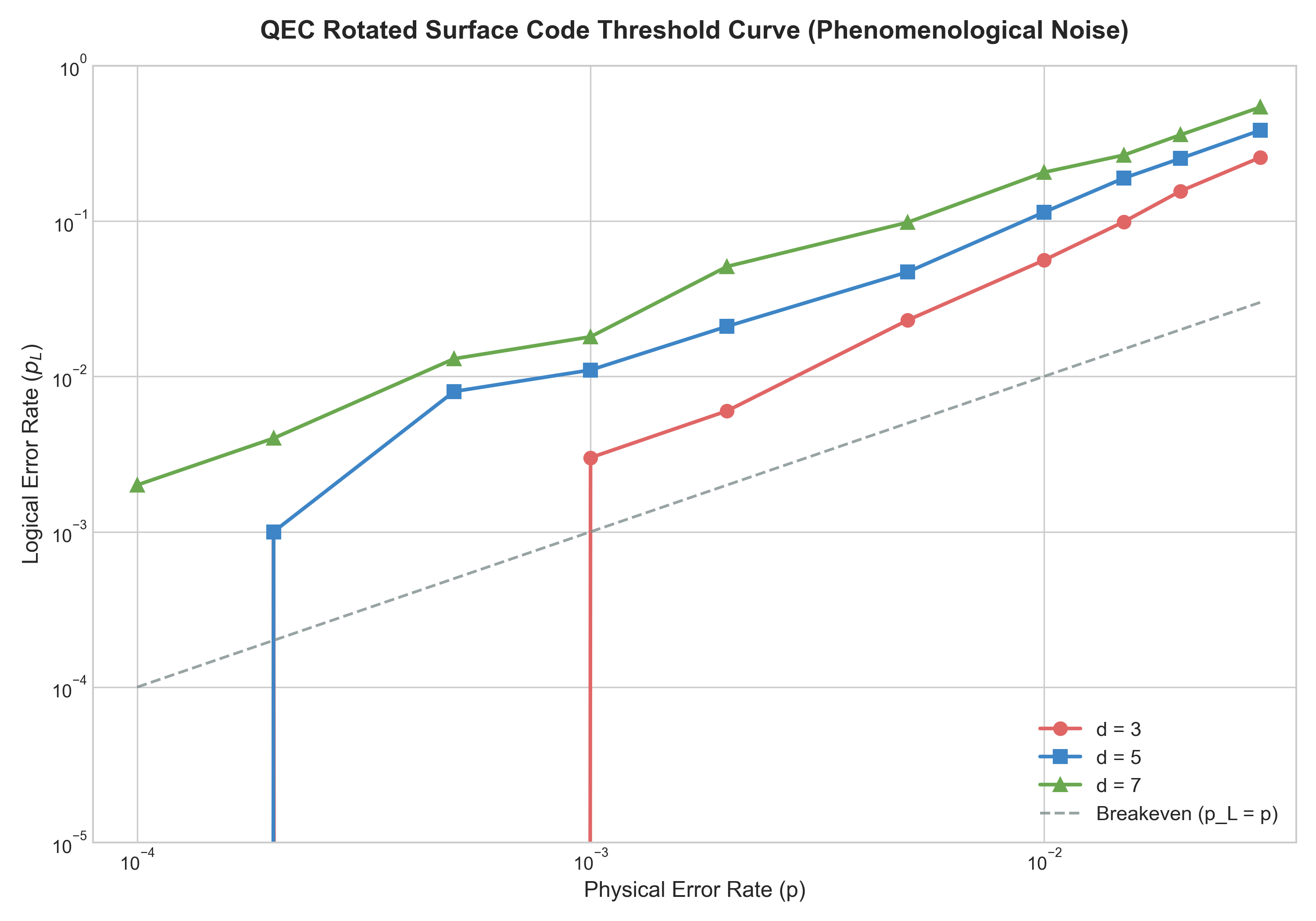
Includes stabilizer measurement errors. Crossing threshold is located at p ≈ 1.5%.
Simulation Statistics (Logical Error Rates)
| Mode | Distance (d) | p = 1.0% | p = 0.5% | p = 0.2% |
|---|---|---|---|---|
| Data Noise Only (Perfect Measurements) |
d = 3 | 0.35% | 0.10% | 0.00% |
| d = 5 | 0.05% | 0.00% | 0.00% | |
| d = 7 | 0.00% | 0.05% | 0.00% | |
| Phenomenological Noise (Faulty Measurements) |
d = 3 | 5.00% | 2.00% | 1.10% |
| d = 5 | 11.90% | 6.40% | 1.70% | |
| d = 7 | 18.10% | 11.10% | 5.40% |
Technical Details
- Clifford Simulator: Tracks stabilizer states using a packed binary symplectic tableau. All update operations utilize fast CPU-level word bitwise XORs.
- Union-Find Decoder: Disjoint-set implementation with rank-based unions and path compression. Peeling decoder runs in reverse BFS order from leaf nodes to verify parity.
- Greedy Decoder: Compares active defects pairwise or to boundaries using BFS shortest-path trees to find minimum weight pairings.
- XZZX Surface Code: Variants feature high thresholds under biased noise. Under XZZX, all stabilizers measure alternating X and Z operators.